Archives November 2018

JTPLF Participates In #GivingTuesday

Black Friday. Cyber Monday. Giving Tuesday.

On November 27th, we are participating in a national day of generosity, #GivingTuesday.

This year, we are aiming to raise $1,000 to enhance our STEAM (science, technology, engineering, art, and math) programming with the addition of new coding kits.

Code.org states that the lack of exposure to coding and computer science programs in school has led to open positions in the 21st century job market.  “More than 58% of the new STEM jobs are in computing and computer science, but only 8 percent of STEM graduates are in computer science.”

In Indiana alone, there are 5,010 open computing jobs.  Youth Services librarians believe that we can help bridge this employment gap for the future, by exposing young people to coding and computer science now.  If we can offer coding and computer science in a fun and relaxed atmosphere a budding programmer, web developer, or systems analyst can gain the basic skills, practice, and confidence they will need to contribute and find success in the 21st century workforce.

unnamed (1)

The kit is a resource rich introduction to game based coding and engineering.  Each kit comes with enough material for users to build four different games and inventions.  All the materials in the kit are reusable which will give the library multiple programming options.  These kits encourage collaboration and working together among our young people which is another appealing aspect of this product.

Will you assist in raising $1,000 to enhance our STEAM programming and ensure that children have access to high-quality, learning resources.

Make a gift today by clicking on the link: https://jefflibraryfoundation.org/donate/

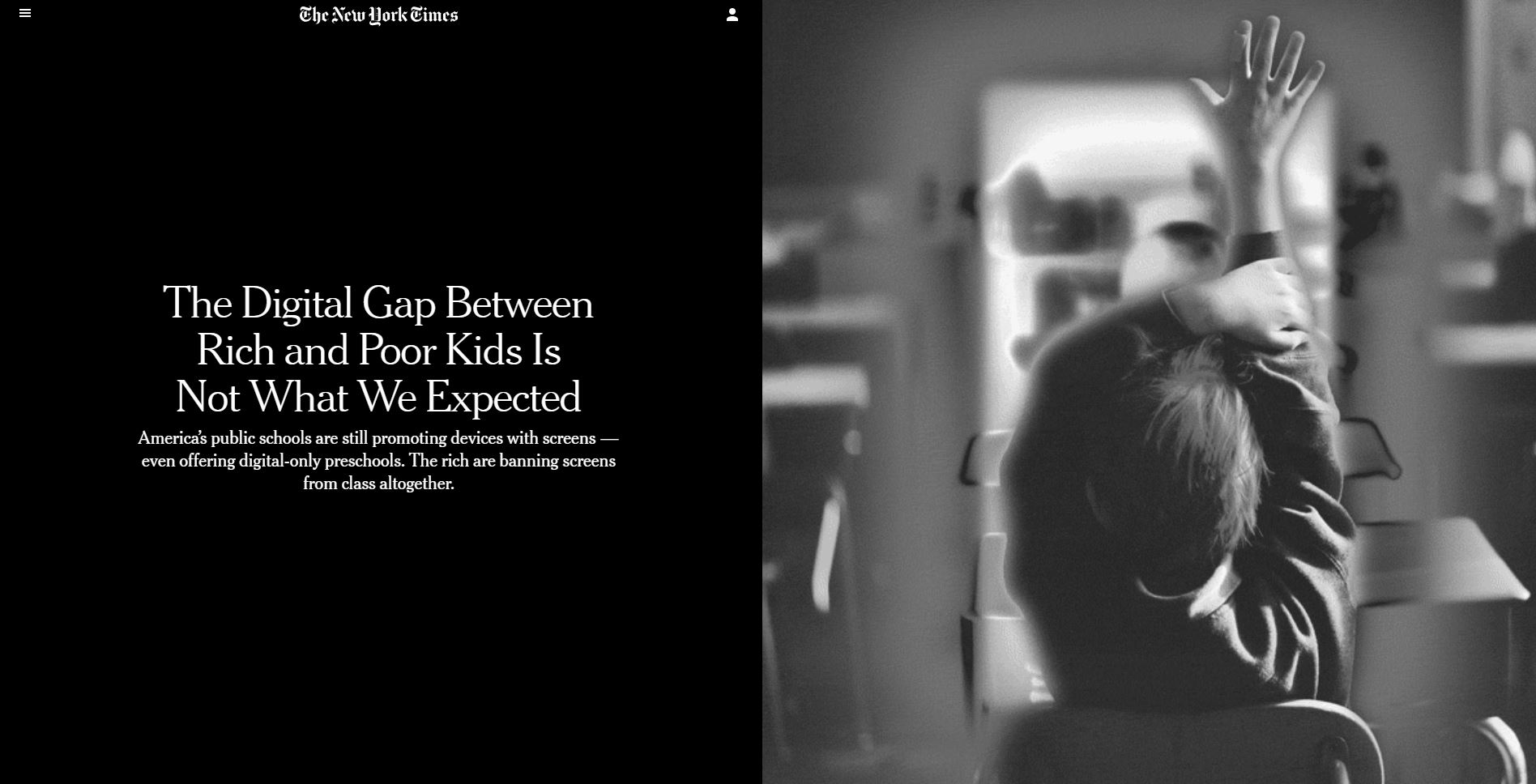
ARTICLE: The Digital Gap Between Rich and Poor Kids Is Not What We Expected

story from the Oct. 26 issue of The New York Times


The parents in Overland Park, Kan., were fed up. They wanted their children off screens, but they needed strength in numbers. First, because no one wants their kid to be the lone weird one without a phone. And second, because taking the phone away from a middle schooler is actually very, very tough.

“We start the meetings by saying, ‘This is hard, we’re in a new frontier, but who is going to help us?’” said Krista Boan, who is leading a Kansas City-based program called START, which stands for Stand Together And Rethink Technology. “We can’t call our moms about this one.”

For the last six months, at night in school libraries across Overland Park, a suburb of Kansas City, Mo., about 150 parents have been meeting to talk about one thing: how to get their children off screens.

It wasn’t long ago that the worry was that rich students would have access to the internet earlier, gaining tech skills and creating a digital divide. Schools ask students to do homework online, while only about two-thirds of people in the U.S. have broadband internet service. But now, as Silicon Valley’s parents increasingly panic over the impact screens have on their children and move toward screen-free lifestyles, worries over a new digital divide are rising. It could happen that the children of poorer and middle-class parents will be raised by screens, while the children of Silicon Valley’s elite will be going back to wooden toys and the luxury of human interaction.

This is already playing out. Throwback play-based preschools are trending in affluent neighborhoods — but Utah has been rolling out a state-funded online-only preschool, now serving around 10,000 children. Organizers announced that the screen-based preschool effort would expand in 2019 with a federal grant to Wyoming, North Dakota, South Dakota, Idaho and Montana.

Lower-income teenagers spend an average of eight hours and seven minutes a day using screens for entertainment, while higher income peers spend five hours and 42 minutes, according to research by Common Sense Media, a nonprofit media watchdog. (This study counted each screen separately, so a child texting on a phone and watching TV for one hour counted as two hours of screens being used.) Two studies that look at race have found that white children are exposed to screens significantly less than African-American and Hispanic children.

And parents say there is a growing technological divide between public and private schools even in the same community. While the private Waldorf School of the Peninsula, popular with Silicon Valley executives, eschews most screens, the nearby public Hillview Middle School advertises its 1:1 iPad program.

The psychologist Richard Freed, who wrote a book about the dangers of screen-time for children and how to connect them back to real world experiences, divides his time between speaking before packed rooms in Silicon Valley and his clinical practice with low-income families in the far East Bay, where he is often the first one to tell parents that limiting screen-time might help with attention and behavior issues.

“I go from speaking to a group in Palo Alto who have read my book to Antioch, where I am the first person to mention any of these risks,” Dr. Freed said.

He worries especially about how the psychologists who work for these companies make the tools phenomenally addictive, as many are well-versed in the field of persuasive design (or how to influence human behavior through the screen). Examples: YouTube next video autoplays; the slot machine-like pleasure of refreshing Instagram for likes; Snapchat streaks.

“The digital divide was about access to technology, and now that everyone has access, the new digital divide is limiting access to technology,” said Chris Anderson, the former editor of Wired magazine.

Some parents, pediatricians and teachers around the country are pushing back.

“These companies lied to the schools, and they’re lying to the parents,” said Natasha Burgert, a pediatrician in Kansas City. “We’re all getting duped.”

“Our kids, my kids included, we are subjecting them to one of the biggest social experiments we have seen in a long time,” she said. “What happens to my daughter if she can’t communicate over dinner — how is she going to find a spouse? How is she going to interview for a job?”

“I have families now that go teetotal,” Dr. Burgert said. “They’re like, ‘That’s it, we’re done.’”

One of those families are the Brownsbergers, who had long banned smartphones but recently also banned the internet-connected television.

“We took it down, we took the TV off the wall, and I canceled cable,” said Rachael Brownsberger, 34, the mother of 11- and 8-year old boys. “As crazy as that sounds!”

A Dark Consensus About Screens and Kids Begins to Emerge in Silicon Valley
“I am convinced the devil lives in our phones.”

His Christmas wish list was a Wii, a PlayStation, a Nintendo, a MacBook Pro and an iPhone.

“And I told him, ‘Kiddo, you’re not gonna get one of those things,’” Ms. Brownsberger said. “Yeah, I’m the mean mom.”

But one thing has made it easier: Others in what she described as a rural neighborhood outside Kansas City are doing the same thing.

“It takes a community to support this,” she said. “Like I was just talking to my neighbor last night — ‘Am I the worst mom ever?’”

Ms. Boan has three pilots running with about 40 parents in each, looking at best practices for getting kids off phones and screens. Overland Park’s Chamber of Commerce is supporting the work, and the city is working to incorporate elements of digital wellness into its new strategic vision.

“The city planner and the chamber of commerce said to us, ‘We’ve seen this impact our city,’” Ms. Boan said. “We all want our kids to be independent, self-regulated device users, but we have to equip them.”

In Silicon Valley, some feel anxious about the growing class divide they see around screen-time.

Kirstin Stecher and her husband, who works as an engineer at Facebook, are raising their kids almost completely screen-free.

“Is this coming from a place of information — like, we know a lot about these screens,” she said. “Or is it coming from a place of privilege, that we don’t need them as badly?”

“There’s a message out there that your child is going to be crippled and in a different dimension if they’re not on the screen,” said Pierre Laurent, a former Microsoft and Intel executive now on the board of trustees at Silicon Valley’s Waldorf School. “That message doesn’t play as well in this part of the world.”

“People in this region of the world understand that the real thing is everything that’s happening around big data, AI, and that is not something that you’re going to be particularly good at because you have a cellphone in fourth grade,” Mr. Laurent said.

As those working to build products become more wary, the business of getting screens in front of kids is booming. Apple and Google compete ferociously to get products into schools and target students at an early age, when brand loyalty begins to form.

Google published a case study of its work with the Hoover City, Ala., school district, saying technology equips students “with skills of the future.”

The company concluded that its own Chromebooks and Google tools changed lives: “The district leaders believe in preparing students for success by teaching them the skills, knowledge, and behaviors they need to become responsible citizens in the global community.”

Dr. Freed, though, argues these tools are too relied upon in schools for low-income children. And he sees the divide every day as he meets tech-addicted children of middle and low-income families.

“For a lot of kids in Antioch, those schools don’t have the resources for extracurricular activities, and their parents can’t afford nannies,” Dr. Freed said. He said the knowledge gap around tech’s danger is enormous.

Dr. Freed and 200 other psychologists petitioned the American Psychological Association in August to formally condemn the work psychologists are doing with persuasive design for tech platforms that are designed for children.

“Once it sinks its teeth into these kids, it’s really hard,” Dr. Freed said.

Nellie Bowles covers tech and internet culture. Follow her on Twitter: @nelliebowles

A version of this article appears in print on , on Page B3 of the New York edition with the headline: Rich Parents Ban Devices As the Poor Grow Reliant. Order Reprints | Today’s Paper | Subscribe

Why Bonnie Prince Billy is Trading Microphone for Library Card

story originally appeared in Courier Journal, Oct. 16, 2018

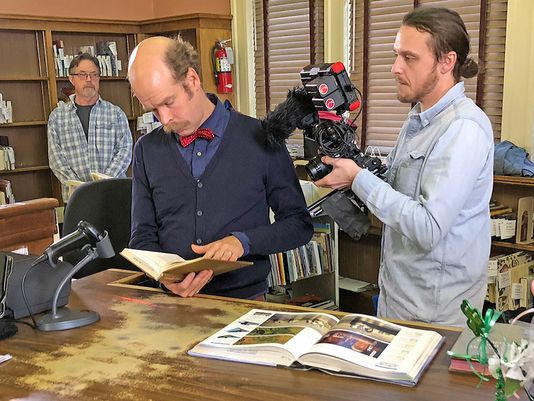
Story by Kirby Adams | Photo by John Kasey

Louisville folk singer-songwriter Will Oldham, known internationally as Bonnie ‘Prince’ Billy, takes center stage this month not with his usual guitar and microphone but as the quirky narrator of “Our Library,” a documentary about the Louisville Public Library system.

What kind of quirky? Think if Willy Wonka owned a library rather than a chocolate factory.

Oldham, who appeared in John Sayles’ critically acclaimed movie “Matewan” in 1987, has also starred in several well-regarded films such as “Old Joy,” “Wendy and Lucy” and “New Jerusalem.”

Thursday, Oldham will take part in a special screening event for the documentary by longtime Louisville filmmaker Morgan Atkinson.

“There’s a lot of negativity in the public sphere right now,” Atkinson said. “I wanted to show a public institution that really served the community well, was truly irreplaceable and yet was too often under-appreciated. The Library was a subject made-to-order.”

The free public screening of “Our Library” will be held at the Ursuline Arts Center, 3105 Lexington Road, on Oct. 18 at 7:30 p.m.

If you can’t make the free screening, the documentary will begin airing on KET Oct. 22 at 10 p.m., right in the midst of National Friends of Libraries Week, Oct. 21-27. Check KET listings for further air dates.

“Our Library” is Atkinson’s 18th full-length documentary to be broadcast on KET. His films have ranged in subject matter from the ill-fated Louisville Falls Fountain to profiles of people such as Thomas MertonHarlan HubbardJohn Howard Griffin and Tim Krekel. Other subjects have included Beargrass Creek, high school basketball and government merger in Louisville.

Reach Kirby Adams at kadams@courier-journal.com Twitter @kirbylouisville. Support strong local journalism by subscribing today: courier-journal.com/kirbya

The Key to Happiness Found in Library, Park

Book review by Pete Buttigieg — Mayor of South Bend, Ind.

as seen in The New York Times, Sept. 14, 2018

PALACES FOR THE PEOPLE
How Social Infrastructure Can Help Fight Inequality, Polarization, and the Decline of Civic Life

By Eric Klinenberg
277 pp. Crown. $28.

This time of year, my wooden desktop in the Office of the Mayor looks very similar to my computer desktop: covered in spreadsheets. It’s budget season in South Bend, Ind. — the annual reckoning. Priorities jostle against one another, and sometimes it feels as if we must choose between investing in places (fire stations, streetscapes) and investing in people (after-school programs, job training). We do some of both, of course, but the process forces us to balance two concepts of what a city is: a place and a population.

In “Palaces for the People,” Eric Klinenberg offers a new perspective on what people and places have to do with each other, by looking at the social side of our physical spaces. He is not the first to use the term “social infrastructure,” but he gives it a new and useful definition as “the physical conditions that determine whether social capital develops,” whether, that is, human connection and relationships are fostered. Then he presents examples intended to prove that social infrastructure represents the key to safety and prosperity in 21st-century urban America.

Klinenberg is an N.Y.U. sociologist best known recently as Aziz Ansari’s co-author for “Modern Romance,” in which he helped the comedian apply social science tools to better understand dating. Here, he begins with questions he first addressed in an earlier book on a lethal heat wave that struck Chicago in 1995. He asked how two adjacent poor neighborhoods on the South Side, demographically similar and presumably equally vulnerable, could fare so differently in the disaster. Why did elderly victims in the Englewood neighborhood lose their lives at 10 times the rate of those in Auburn Gresham?

The explanation had to do with social capital, the amount of interpersonal contact that exists in a community. In the neighborhood with fewer fatalities, people checked on one another and knew where to go for help; in the other, social isolation was the norm, with residents more often left to fend for themselves, even to perish in sweltering housing units. Crucially, these were not cultural or economic differences, but rather had to do with things like the density of shops and the vacancy rate along streets, which either helped or hurt people get to know one another in their communities.

The new book’s exploration of this reality begins in the basement of a library in a low-income Brooklyn neighborhood, where an Xbox-based bowling competition pits local seniors against rival teams from a dozen library branches across the borough. The example of a virtual bowling league has particular poetic resonance two decades after Robert Putnam, the Harvard political scientist, raised fears of societal collapse in his study “Bowling Alone.” Where Putnam charted the decline of American communal participation through shrinking bowling league membership, Klinenberg’s basement of virtual bowlers illustrates how technology might actually enhance our social fabric — provided there are supportive spaces. Given what we have learned about the health impacts of social isolation among the elderly, lives may depend on creating more such opportunities.

Klinenberg finds in libraries “the textbook example of social infrastructure in action,” a shared space where everyone from schoolchildren doing homework to the video-gaming elderly can get to know one another better. For him, the presence of destitute or mentally ill visitors is a feature, not a bug, of libraries, because it requires people to confront radical differences in a shared space.

Klinenberg extends the idea of social infrastructure to grade schools, college campuses, public housing, private apartment buildings, coffee shops, sidewalks, pocket parks, churches, murals, even flood-management projects in Singapore and public pools in Iceland. Pretty much any space that can affect the social fabric is within the author’s scope. Here, social infrastructure is not a subset of what we call “infrastructure” but something broader, which makes his project ambitious but also perhaps too vague: After all, if it could include virtually all public and many private or even virtual spaces, is the category even useful?

It is, especially when Klinenberg discusses social infrastructure in terms of quality, not just quantity. While some of his examples simply reinforce the inarguable fact that we need more of these resources (more libraries! more gyms! more gardens!), his most illuminating cases gauge what happens in spaces whose designs are either socially helpful or harmful. Social infrastructure becomes less a thing to maximize than a lens that communities and policymakers should apply to every routine decision about physical investment: Do the features of this proposed school, park or sewer system tend to help human beings to form connections?

In case after case, we learn how socially-minded design matters. A vaunted housing project built in 1950s St. Louis quickly became a nightmare of crime and vandalism; a smaller, adjacent complex remained relatively free of trouble because its design promoted “informal surveillance” and care of common spaces by neighbors. The reconfiguration of large urban schools into smaller, more manageable ones now shows promise in boosting graduation rates in New York — partly because this allows parents, students and teachers to form a community in which problems are addressed informally before they can disrupt learning.

Meanwhile, much of our built environment contains negative or “exclusive social infrastructure,” including gated communities in the United States and South Africa, and college fraternities, which Klinenberg condemns categorically based on their association with substance abuse and sexual assault. (The construction of a massive wall, unsurprisingly, is an example of public investment that is not conducive to social infrastructure.)

Much of the book’s most interesting content has to do with climate security. From the informal network of Houston churches that kicked into gear after Hurricane Harvey, to the unlikely rise of the Rockaway Beach Surf Club in New York as a vital hub of recovery after Hurricane Sandy, we see how the right kind of social infrastructure can aid struggling communities and even save lives by connecting people during and after disasters. As Klinenberg observes, “when hard infrastructure fails … it’s the softer, social infrastructure that determines our fate.”

Klinenberg’s approach even lets him apply appealing nuance to precincts of our social life that have become objects of simplistic head-shaking and finger-wagging. When it comes to social media, for example, he takes a look at online communities, especially for young people, and pointedly suggests that teenagers turn to the digital realm largely because they have little alternative. Modern parenting norms make it less likely they will be allowed to physically move around their neighborhoods and communities. When unable to use traditional spaces like streets or parks, young people have no choice but to rely on the internet as their primary social infrastructure. It’s a point that should invite introspection among parents who require their children to remain within sight, then scold them for spending too much time looking at screens.

“Palaces for the People” reads more like a succession of case studies than a comprehensive account of what social infrastructure is, so those looking for a theoretical framework may be disappointed. But anyone interested in cities will find this book an engaging survey that trains you to view any shared physical system as, among other things, a kind of social network. After finishing it, I started asking how ordinary features of my city, from streetlights to flowerpots, might affect the greater well-being of residents. Physically robust infrastructure is not enough if it fails to foster a healthy community; ultimately, all infrastructure is social.

Pete Buttigieg is the mayor of South Bend, Ind. His first book, “Shortest Way Home: One Mayor’s Challenge and a Model for America’s Future,” will be published in January.

A version of this article appears in print on Sept. 16, 2018, on Page 19 of the Sunday Book Review with the headline: Public Space.

Classes: November 2018

You can view ALL of our November class offerings on right side of this page.

Storytime at Brilliant Bumble Bee

Friday, Nov. 2 | 10 a.m. – 11 a.m. | 426 Spring St., Jeffersonville, IN 47130

ST @ Brilliant Bumble Bee

Do you have a little one you would like to expose to reading? Well the Brilliant Bumble Bee, located at 426 Spring St. in downtown Jeffersonville is offering a free get together for children aged 0-5. Your kids can participate in stories, music, crafts and other fun activities!

Let’s Color: Adult Coloring Book Session

Tuesday, Nov. 6 | 10:30 a.m. – 12:00 noon & Wednesday, Nov. 21 | 2:00 – 3:30 pmLet_s Color

Sometimes, adults even need to color. If you need to de-stress, attend one of our two events focused on adult coloring sessions. Come back and be a kid again!

STEAM Day

Steam Day

Thursday, Nov. 8 | 4:00 – 5:00 pm
STEAM, which stands for Science, Technology, Engineering, Arts and Mathematics, is taking over the United States. Is your child interested in any of these subjects? Then this special day is just for them! This event is intended for students in grades 3-6, and will focus on learning outside of the classroom. We hope to see you there!

Crocheting Class for Beginners

Crochet Class

Saturday, Nov. 10 & 24 | 12:00 – 2:00 pm

Want to learn how to crochet? Well the JTPL is offering a Crocheting Class for beginners, presented by Joyce Ellis, on Saturday, Oct. 27 from noon – 2 pm in the North Program Room.

PLEASE BRING: Either a size H or I crochet needle, and a 5-7 oz. skein of “I Love This Yarn”, which can be found at Hobby Lobby.


Teens Create

Teens Create

Tuesday, Nov. 13 | 4:00 – 5:30 pm

Are you a bored teenager looking for something to do? Then check out the Teens Create session at the library, intended for students in grades 6-12! This month, the group will be focusing on Mandala Leaf Printing. All materials will be provided, just be sure to wear old t-shirts or smocks! Registration is requested, and all support is provided by the CCYC.

Feature Film Series: Ocean’s 8

Feature Film Series

Saturday, Nov. 17 | 2:00 – 4:00 pm | Ages 18+

If you are a lover of films, then you won’t want to miss this month’s flick in the Feature Film Series: Ocean’s 8. Based on the plot from Ocean’s 9, Ocean’s 10 and Ocean’s 11, this reboot features an all-female cast, led by Sandra Bullock. You won’t want to miss this adventurous, hilarious movie! Must be 18 or older to attend.