Why Bonnie Prince Billy is Trading Microphone for Library Card

story originally appeared in Courier Journal, Oct. 16, 2018

Story by Kirby Adams | Photo by John Kasey

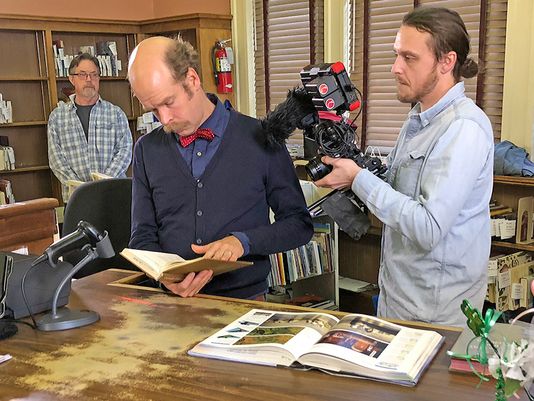
Louisville folk singer-songwriter Will Oldham, known internationally as Bonnie ‘Prince’ Billy, takes center stage this month not with his usual guitar and microphone but as the quirky narrator of “Our Library,” a documentary about the Louisville Public Library system.

What kind of quirky? Think if Willy Wonka owned a library rather than a chocolate factory.

Oldham, who appeared in John Sayles’ critically acclaimed movie “Matewan” in 1987, has also starred in several well-regarded films such as “Old Joy,” “Wendy and Lucy” and “New Jerusalem.”

Thursday, Oldham will take part in a special screening event for the documentary by longtime Louisville filmmaker Morgan Atkinson.

“There’s a lot of negativity in the public sphere right now,” Atkinson said. “I wanted to show a public institution that really served the community well, was truly irreplaceable and yet was too often under-appreciated. The Library was a subject made-to-order.”

The free public screening of “Our Library” will be held at the Ursuline Arts Center, 3105 Lexington Road, on Oct. 18 at 7:30 p.m.

If you can’t make the free screening, the documentary will begin airing on KET Oct. 22 at 10 p.m., right in the midst of National Friends of Libraries Week, Oct. 21-27. Check KET listings for further air dates.

“Our Library” is Atkinson’s 18th full-length documentary to be broadcast on KET. His films have ranged in subject matter from the ill-fated Louisville Falls Fountain to profiles of people such as Thomas Merton, Harlan Hubbard, John Howard Griffin and Tim Krekel. Other subjects have included Beargrass Creek, high school basketball and government merger in Louisville.

Reach Kirby Adams at kadams@courier-journal.com Twitter @kirbylouisville. Support strong local journalism by subscribing today: courier-journal.com/kirbya

The Key to Happiness Found in Library, Park

Book review by Pete Buttigieg — Mayor of South Bend, Ind.

as seen in The New York Times, Sept. 14, 2018

PALACES FOR THE PEOPLE
How Social Infrastructure Can Help Fight Inequality, Polarization, and the Decline of Civic Life

By Eric Klinenberg
277 pp. Crown. $28.

This time of year, my wooden desktop in the Office of the Mayor looks very similar to my computer desktop: covered in spreadsheets. It’s budget season in South Bend, Ind. — the annual reckoning. Priorities jostle against one another, and sometimes it feels as if we must choose between investing in places (fire stations, streetscapes) and investing in people (after-school programs, job training). We do some of both, of course, but the process forces us to balance two concepts of what a city is: a place and a population.

In “Palaces for the People,” Eric Klinenberg offers a new perspective on what people and places have to do with each other, by looking at the social side of our physical spaces. He is not the first to use the term “social infrastructure,” but he gives it a new and useful definition as “the physical conditions that determine whether social capital develops,” whether, that is, human connection and relationships are fostered. Then he presents examples intended to prove that social infrastructure represents the key to safety and prosperity in 21st-century urban America.

Klinenberg is an N.Y.U. sociologist best known recently as Aziz Ansari’s co-author for “Modern Romance,” in which he helped the comedian apply social science tools to better understand dating. Here, he begins with questions he first addressed in an earlier book on a lethal heat wave that struck Chicago in 1995. He asked how two adjacent poor neighborhoods on the South Side, demographically similar and presumably equally vulnerable, could fare so differently in the disaster. Why did elderly victims in the Englewood neighborhood lose their lives at 10 times the rate of those in Auburn Gresham?

The explanation had to do with social capital, the amount of interpersonal contact that exists in a community. In the neighborhood with fewer fatalities, people checked on one another and knew where to go for help; in the other, social isolation was the norm, with residents more often left to fend for themselves, even to perish in sweltering housing units. Crucially, these were not cultural or economic differences, but rather had to do with things like the density of shops and the vacancy rate along streets, which either helped or hurt people get to know one another in their communities.

The new book’s exploration of this reality begins in the basement of a library in a low-income Brooklyn neighborhood, where an Xbox-based bowling competition pits local seniors against rival teams from a dozen library branches across the borough. The example of a virtual bowling league has particular poetic resonance two decades after Robert Putnam, the Harvard political scientist, raised fears of societal collapse in his study “Bowling Alone.” Where Putnam charted the decline of American communal participation through shrinking bowling league membership, Klinenberg’s basement of virtual bowlers illustrates how technology might actually enhance our social fabric — provided there are supportive spaces. Given what we have learned about the health impacts of social isolation among the elderly, lives may depend on creating more such opportunities.

Klinenberg finds in libraries “the textbook example of social infrastructure in action,” a shared space where everyone from schoolchildren doing homework to the video-gaming elderly can get to know one another better. For him, the presence of destitute or mentally ill visitors is a feature, not a bug, of libraries, because it requires people to confront radical differences in a shared space.

Klinenberg extends the idea of social infrastructure to grade schools, college campuses, public housing, private apartment buildings, coffee shops, sidewalks, pocket parks, churches, murals, even flood-management projects in Singapore and public pools in Iceland. Pretty much any space that can affect the social fabric is within the author’s scope. Here, social infrastructure is not a subset of what we call “infrastructure” but something broader, which makes his project ambitious but also perhaps too vague: After all, if it could include virtually all public and many private or even virtual spaces, is the category even useful?

It is, especially when Klinenberg discusses social infrastructure in terms of quality, not just quantity. While some of his examples simply reinforce the inarguable fact that we need more of these resources (more libraries! more gyms! more gardens!), his most illuminating cases gauge what happens in spaces whose designs are either socially helpful or harmful. Social infrastructure becomes less a thing to maximize than a lens that communities and policymakers should apply to every routine decision about physical investment: Do the features of this proposed school, park or sewer system tend to help human beings to form connections?

In case after case, we learn how socially-minded design matters. A vaunted housing project built in 1950s St. Louis quickly became a nightmare of crime and vandalism; a smaller, adjacent complex remained relatively free of trouble because its design promoted “informal surveillance” and care of common spaces by neighbors. The reconfiguration of large urban schools into smaller, more manageable ones now shows promise in boosting graduation rates in New York — partly because this allows parents, students and teachers to form a community in which problems are addressed informally before they can disrupt learning.

Meanwhile, much of our built environment contains negative or “exclusive social infrastructure,” including gated communities in the United States and South Africa, and college fraternities, which Klinenberg condemns categorically based on their association with substance abuse and sexual assault. (The construction of a massive wall, unsurprisingly, is an example of public investment that is not conducive to social infrastructure.)

Much of the book’s most interesting content has to do with climate security. From the informal network of Houston churches that kicked into gear after Hurricane Harvey, to the unlikely rise of the Rockaway Beach Surf Club in New York as a vital hub of recovery after Hurricane Sandy, we see how the right kind of social infrastructure can aid struggling communities and even save lives by connecting people during and after disasters. As Klinenberg observes, “when hard infrastructure fails … it’s the softer, social infrastructure that determines our fate.”

Klinenberg’s approach even lets him apply appealing nuance to precincts of our social life that have become objects of simplistic head-shaking and finger-wagging. When it comes to social media, for example, he takes a look at online communities, especially for young people, and pointedly suggests that teenagers turn to the digital realm largely because they have little alternative. Modern parenting norms make it less likely they will be allowed to physically move around their neighborhoods and communities. When unable to use traditional spaces like streets or parks, young people have no choice but to rely on the internet as their primary social infrastructure. It’s a point that should invite introspection among parents who require their children to remain within sight, then scold them for spending too much time looking at screens.

“Palaces for the People” reads more like a succession of case studies than a comprehensive account of what social infrastructure is, so those looking for a theoretical framework may be disappointed. But anyone interested in cities will find this book an engaging survey that trains you to view any shared physical system as, among other things, a kind of social network. After finishing it, I started asking how ordinary features of my city, from streetlights to flowerpots, might affect the greater well-being of residents. Physically robust infrastructure is not enough if it fails to foster a healthy community; ultimately, all infrastructure is social.

Pete Buttigieg is the mayor of South Bend, Ind. His first book, “Shortest Way Home: One Mayor’s Challenge and a Model for America’s Future,” will be published in January.

A version of this article appears in print on Sept. 16, 2018, on Page 19 of the Sunday Book Review with the headline: Public Space.
Classes: November 2018

You can view ALL of our November class offerings on right side of this page.

Storytime at Brilliant Bumble Bee

Friday, Nov. 2 | 10 a.m. – 11 a.m. | 426 Spring St., Jeffersonville, IN 47130

ST @ Brilliant Bumble Bee

Do you have a little one you would like to expose to reading? Well the Brilliant Bumble Bee, located at 426 Spring St. in downtown Jeffersonville is offering a free get together for children aged 0-5. Your kids can participate in stories, music, crafts and other fun activities!

—

Let’s Color: Adult Coloring Book Session

Tuesday, Nov. 6 | 10:30 a.m. – 12:00 noon & Wednesday, Nov. 21 | 2:00 – 3:30 pmLet_s Color

Sometimes, adults even need to color. If you need to de-stress, attend one of our two events focused on adult coloring sessions. Come back and be a kid again!
—

STEAM Day

Steam Day

Thursday, Nov. 8 | 4:00 – 5:00 pm
STEAM, which stands for Science, Technology, Engineering, Arts and Mathematics, is taking over the United States. Is your child interested in any of these subjects? Then this special day is just for them! This event is intended for students in grades 3-6, and will focus on learning outside of the classroom. We hope to see you there!
—

Crocheting Class for Beginners

Crochet Class

Saturday, Nov. 10 & 24 | 12:00 – 2:00 pm

Want to learn how to crochet? Well the JTPL is offering a Crocheting Class for beginners, presented by Joyce Ellis, on Saturday, Oct. 27 from noon – 2 pm in the North Program Room.

PLEASE BRING: Either a size H or I crochet needle, and a 5-7 oz. skein of “I Love This Yarn”, which can be found at Hobby Lobby.


—

Teens Create

Teens Create

Tuesday, Nov. 13 | 4:00 – 5:30 pm

Are you a bored teenager looking for something to do? Then check out the Teens Create session at the library, intended for students in grades 6-12! This month, the group will be focusing on Mandala Leaf Printing. All materials will be provided, just be sure to wear old t-shirts or smocks! Registration is requested, and all support is provided by the CCYC.

—

Feature Film Series: Ocean’s 8

Feature Film Series

Saturday, Nov. 17 | 2:00 – 4:00 pm | Ages 18+

If you are a lover of films, then you won’t want to miss this month’s flick in the Feature Film Series: Ocean’s 8. Based on the plot from Ocean’s 9, Ocean’s 10 and Ocean’s 11, this reboot features an all-female cast, led by Sandra Bullock. You won’t want to miss this adventurous, hilarious movie! Must be 18 or older to attend.

Changes Coming to Jeff, Clarksville Libraries

The Town of Clarksville Redevelopment Commission recently approved using $75,000 from local Tax Increment Financing funds to help with purchasing and installing new technology equipment for the ongoing renovation and expansion of the Clarksville Branch of the Jeffersonville Township Public Library.

A $5000 grant from WHAS Crusade for Children will be used to provide interactive and engaging computer programs and tablets designed to develop mental, emotional, and social skills in a fun, interactive format for special needs children at both the Clarksville branch of the Jeffersonville Township Public Library and the main JTPL library on Court Avenue in Jeffersonville.

The Clarksville expansion project features a 1,723 square foot extension with an abundance of new technology. New and renovated space includes a large new meeting room capable of being partitioned into 2 smaller rooms and 3 new study rooms

Thanks to this grant from the town of Clarksville, library director Libby Pollard says, “The upgrades and addition of technology at the Clarksville Branch Library will help insure that the residents of Clarksville have access to the latest technology. We will also utilize a new mobile lab to teach classes on email, internet, and Microsoft Office applications such as Microsoft Word. These classes will help Clarksville residents stay current with ever changing technology.”

Major renovations are also planned at the main JTPL library in Jeffersonville. The WHAS Crusade for Children grant, according to Pollard, “will allow the addition of new and supportive features for our special needs youth and their families, a long-term goal that highlights the library’s core values of fostering an inclusive community, providing friendly service, and encouraging lifelong learning” at both the main library and the Clarksville branch.

Examples of technology this grant may support include a computerized station full of interactive and engaging content focusing on seven curricular areas and children’s tablets pre-loaded with fun, educational games, movies, and apps, all focused on the needs and abilities of children with special needs.

New technology coming to both the Clarksville branch and the main JTPL library involves RFID – radio-frequency identification – technology, using electromagnetic fields to automatically identify and track special tags attached to books, videos, DVDs and other library material. With the RFID tags customers will no longer stand in line to check out books with the capacity for self-checkout.

by Valerie McCarthy

Slideshow of Progress on Clarksville branch of JTPL:

This slideshow requires JavaScript.

JTPLF awarded WHAS Crusade for Children Grant

from press release | July 13, 2018

The Jeffersonville Township Public Library (JTPL) Foundation has been awarded a WHAS Crusade for Children Grant. The $4,900 grant will be used to support special needs children.

“We are very excited to receive this grant from the WHAS Crusade for Children,” says Libby Pollard, Director of the Jeffersonville Township Public Library. “The library has been wanting to add new and supportive features for our special needs youth and their families. The Crusade has given us the opportunity to do just that.”

All grant purchases will be made using the Crusade’s Mission and Vision statement to make life better for special needs children and to provide resources to help them succeed. The execution of the grant will also highlight the library’s core values of fostering an inclusive community, providing friendly service, and encouraging lifelong learning.

JTPL will utilize the grant money to provide resources for families with special needs children by purchasing toys and tools designed to develop mental, emotional, and social skills in a fun, interactive format. The library is looking at items like the AWE Early Literacy Station (a computerized station full of interactive and engaging content focusing on seven curricular areas) and the Playaway Launchpads (thematic children’s tablets preloaded with fun, educational games, movies, and apps). The library will scrutinize items purchased with the grant to ensure they will be most beneficial to JTPL’s special needs youth.

CLASSES: October 2018

Pilgrim of Time: The Passion and Paintings of Time — by Victor Troutman

October 13 – November 10

Pilgrim of Time

If you’re a lover of the arts, then this event is for you. From Oct. 13 until Nov. 10, Victor Troutman’s “Pilgrim of Time: The Passion and Paintings of Time” will be on display at the library. There will also be a closing reception on Saturday, Nov. 10 from 2-4 pm. For more information, check out his website: victortroutman.com

—

JTPL Anime ClubAnime

Thursday, October 25 | 4:00 – 5:30 pm

In an effort to support teen programming, the JTPL will be hosting an Anime Club on Thursday, Oct. 25 from 4 – 5:30 pm in the Youth Services Activity Room. Any “Otaku” in grades 6-12 is invited to the event!
—

Rock Painting ClassRock Painting Class

Friday, October 26 | 1:00 – 4:00 pm
With Paint Pouring becoming a hot, new trend in painted arts, now you have the opportunity to learn how to do it! On Friday, Oct. 26, there will be a Rock Painting Class from 1 – 4 pm in the North Program Room. Registration is required, as well as a small $5 fee for supplies, but room is limited. We hope to see you there!
—

Crocheting Class for BeginnersCrochet Class

Saturday, October 27 | 12:00 – 2:00 pm

Want to learn how to crochet? Well the JTPL is offering a Crocheting Class for beginners, presented by Joyce Ellis, on Saturday, Oct. 27 from noon – 2 pm in the North Program Room.

PLEASE BRING: Either a size H or I crochet needle, and a 5-7 oz. skein of “I Love This Yarn”, which can be found at Hobby Lobby.

—

Yoga for Beginners and SeniorsYoga

Saturday, October 27 | 2:30 – 3:45 pm

With the holiday season right around the corner, take some time to unwind at our Yoga for Beginners and Seniors on Saturday, Oct. 27 from 2:30-3:45 pm. Learn how to use everyday objects to incorporate yoga into your daily routine. The class is free, but registration is required.

—

Dungeons & DragonsD&D

Monday, October 29 | 4:00 – 5:30 pm

Are you a Dungeons and Dragons fanatic?! Well here is your chance to prove it! Join us on Monday, Oct. 29 from 4 – 5:30 pm in the Youth Services Activity Room for a chance to play the latest version of D&D. No experience necessary, just your imagination! Refreshments will be provided.

— More to come in November! —

The Foundation Needs Your Help!

Through advocacy and fund raising, the JTPL Foundation, Inc., enhances the library’s ability to realize its vision and mission. The goal of the foundation is to supplement regular taxpayer support for the library by:

  • Building an endowment to ensure the viability and sustainability of the library.
  • Seeking additional funds to support enhanced library operations and service offerings.
  • Managing investments for the present and future benefit of the library.

The JTPL Foundation is a 501(c)(3) organization.

New changes coming soon!

It has been awhile, but changes are coming!

The Jeffersonville Township Public Library Foundation’s website and social media is currently undergoing a change to make getting information to you even easier. So please bear with us over the next month, but expect to have some great information on the Foundation, as well as some exciting changes to the library!

If you’re not doing so already, please give us a follow on Facebook and Twitter.