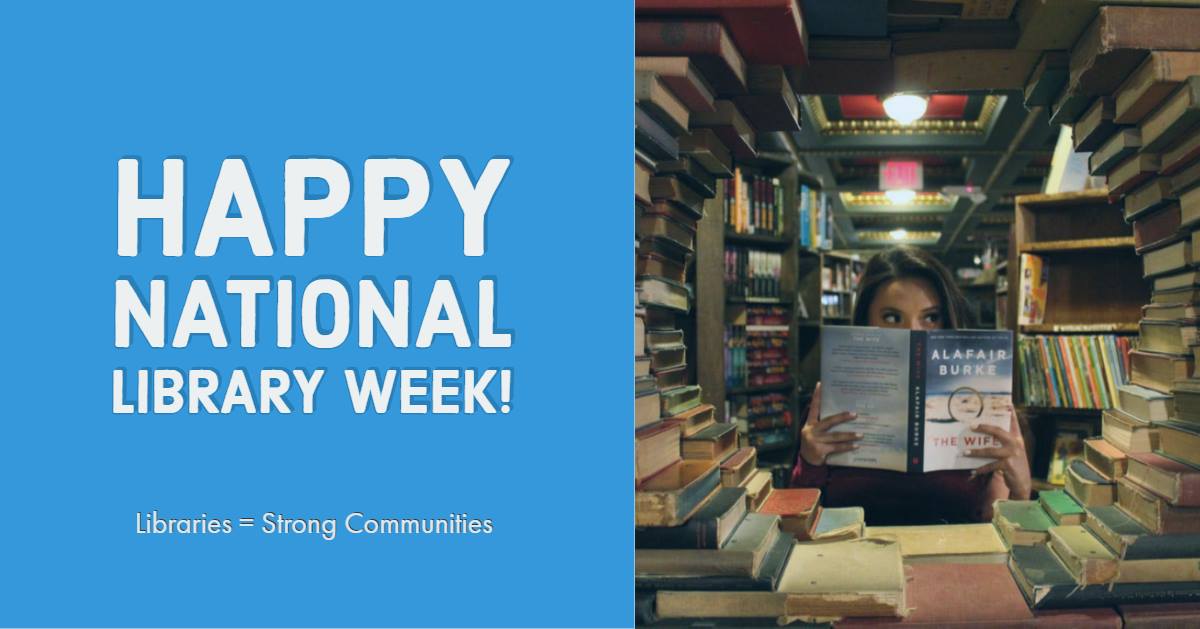
We’re so glad the weather cooperated enough for the Jeffersonville Township Public Library to use the Mobile Book Tricycle! Be on the lookout for it throughout the summer around town!
“National Library Week (April 7- 13) is a great time to remind yourself of all your library has to offer. Whether you check out the library in person or online, you’ll be contributing to your community.”
Don’t forget the Jeffersonville Township Public Library will be temporarily closed for construction beginning April 1, until April 9. While we wait the closure, the changes will make it seem like a brand new library, and frankly, we can’t wait!
Today is the last day of the Jeffersonville Township Public Library ‘STEAM’ Break week as families are welcome to attend the Family STEAM Day from 11-12:30 for Greater Clark County Schools students. The goal is to keep kids’ brains working during their week off of school by introducing science, technology, engineering, arts, and mathematics (STEAM) concepts.
The week was also featured on WLKY News earlier this week! Here is another clip:
Article and Video from WLKY-32 News | March 26, 2019
CLARKSVILLE, Ind. — Jeffersonville Township Public Library is keeping kids brains running with a week full of STEAM break activities while students are on break.
Organizers said students will learn important computer science and computational thinking skills through games and hands-on activities. This program is for grades 3-12.
Monday, March 25 – Maker Mania 2-3 p.m.
Tuesday, March 26 – Code Your World 10-11 a.m.
Wednesday, March 27 – Make It & Take It Craft 3-4 p.m.
This was the first time Congress ever intervened over a Library of Congress subject heading change. Even though many librarians and the American Library Association opposed Congress’s decision, “Illegal aliens” remains the authorized subject heading today.
Cataloging and classification are critical to any library. Without them, finding materials would be impossible. However, there are biases that can result in patrons not getting the materials they need. I have worked in university libraries for over 20 years, and I’d like to highlight some issues of bias that you need to be aware of in order to find what you’re looking for.
How library catalogs work
The U.S. does not have an official national library. However, the Library of Congress fills this role on several fronts.
Many libraries across the U.S. adopt policies established by the Library of Congress, such as their call numbers and subjects for cataloging books. Its subject headings system is one of the most popular in the world.
Subjects are used to assign call numbers, so that items on similar topics are grouped together. An item will have only one call number, but it can have multiple subjects.
Using a specific system ensures consistency. For example, imagine how many variations of “William Shakespeare” you might have to search for if libraries did not use the authorized term “Shakespeare, William, 1564-1616.”
Today, when I search for subjects containing “women” or “men,” the results are unbalanced. There are 4,065 subject terms containing “women” and only 444 containing “men.”
One example of bias is subjects containing the word “astronauts.”
Women are designated with “Women astronauts” and “African American women astronauts,” but there is no subject heading for male astronauts. A book about astronauts who are men would have the general subject “Astronauts,” unless the racial identity prompted the use of a subject like “Hispanic American astronauts” or “Indian astronauts.” Likewise, a book about Russian astronauts would have a geographic subdivision added: “Astronauts – Soviet Union” instead of “Russian astronauts.”
Official Library of Congress subject headings involving astronauts.
Without gender, race or geographic qualifications, “Astronauts” can be assumed to mean white American men in terms of library subjects.
Another exercise I did was to search for professions that are traditionally perceived as female. Nurses, for example, were divided equitably, with subjects for both “Male nurses” and “Female nurses.” However, under “Prostitutes,” there was only a “Male prostitute” subject heading, revealing the generic assumption that most prostitutes are female.
Official Library of Congress subject headings for three professions traditionally perceived as female.
Gender identity is also an area where positive changes have been made. LGBT subjects have been distinguished and classed under “Sexual minorities” since 1972, rather than being under the subject “Sexual deviations,” as they previously were. “Sexual deviations” does not even exist as a subject heading anymore.
In December, the Library of Congress changed the broader term from “sexual minorities” to simply “persons,” in order to align with how other minorities are handled.
The classification dilemma
Many items cover multiple subjects, yet a single physical item can only be shelved in one location. Selecting a call number automatically devalues other subjects, but it must be done.
Catalogers rely upon publisher-assigned subjects and summaries to help assign library subjects. These subjects, the Book Industry Standards and Communications codes, consist of 52 main categories, which are not as specific as Library of Congress subject headings. This can result in incorrect subjects being applied.
For example, I recently cataloged a book about basketball. The BISAC subject was “sports.” While it’s true that basketball is a sport, if I assigned “sports” as the main subject, it would be classed somewhere around GV704, but if I assigned the subject “basketball” it would be classed under GV885. Between these numbers, there could be books covering rules, the Olympics, equipment, air sports, water sports, winter sports and roller skating before the “Ball sports” starting with baseball. This difference could result in the patron not finding the book if browsing the shelves where the other basketball books are.
So the issue is that, by prioritizing certain subjects over one another, it might be more difficult for readers to find what they’re looking for. Women’s history books (HQ1121) may be far away from books about the Depression of 1929 (HB3713); therefore, someone looking for books about the Great Depression might not find the book she needed if it was classed in women’s history.
In my experience, catalogers try to be unbiased when applying subject headings and call numbers. But established subjects are created and adapted based on societal norms. If you can’t find what you need in your library, be aware that the term you use today might not be the term that was previously created. Ask your librarian for help.
Staff of the Jeffersonville Township Public Library (JTPL) would like to give a big THANK YOU to the JTPL Foundation and JTPL Friends of the Library for the purchase of a new Book Bike! We are very excited to add this new service.
JTPL’s new Book Bike
Think of a Book Bike as a mini mobile library on three wheels. Our Book Bike will help us reach out to the community with books, computer classes, kid programs, and a mobile hotspot. In the future, you can look for us at local parks, festivals, and other special events.
Our Book Bike was purchased from Haley Tricycles located in Philadelphia, PA. Haley Tricycles send tricycles all over North America (and sometimes much further.) The library got to participate in the whole experience of the bike building, and even visited the site where the bike was constructed.
We are always looking for opportunities to ride our Book Bike to an event near you. Stay tuned, and continue to check our website for an update on times and dates!
Report from Jeffersonville Township Public Library Youth Services Dept. on progress of Giving Tuesday STEAM Grant
Written by Jennifer Harl
As of Jan. 31, 2019, all items requested in the JTPL Foundation Giving Tuesday Grant proposal have been purchased and received. The grant awarded the library’s youth services department $1,202.75 to purchase coding products that can be used in STEAM (Science, Technology, Engineering, Arts, and Mathematics) programming.
The money raised through the Giving Tuesday campaign made it possible for the Youth Services Department to purchase four Little Bits Coding sets, and one Cubelets Six Robots Blocks set. These kits are top quality products that will support the skills, required of young people in the 21st Century workforce, such as computational thinking, problem solving, and collaboration.
Little Bits Coding set
These kits will be shared and used in programming at both library branches.
The Clarksville Branch library is hosting STEAM Break, which is a series of STEAM-related programs that will be happening during the week of the local schools’ Spring Break session. Public Services Librarian Jennifer Harl plans to introduce both kits at the Family STEAM Day program planned during that week. Family STEAM Day is a program that encourages families to come to the library and experience our STEAM related items such as, robots, marble mazes, KEVA planks, and VR Headsets.
The addition of the Cubelets and Little Bits to our library resources will enhance our existing STEAM programming and open the door for future coding programs. The library is planning to host a Girls Who Code program in the fall and our new kits will be a great addition to that future program. We are excited about the programming opportunities that will come from having these technology-based kits.
Cubelets Six Robot Blocks
This report is submitted with a sincere thanks to the JTPL Foundation Board for raising money on behalf of the JTPL Youth Services. Thank you for allowing us to be a part of the Giving Tuesday campaign. Our staff recognizes that there were many ways this money could be used to support our library, but the JTPL Foundation Board members decided to invest in our library’s youth.
For that, we are very grateful. We look forward to collaborating with the JTPL Foundation again as we work together to support the JTPL mission and vision.